
March 2, 2024
Introduction
In the fertile lands of southeastern Nigeria, the performance arts of the Igbo people blend the physical world with the metaphysical. Traditional Igbo philosophy does not view the secular and the sacred as separate domains; instead, they exist as parallel realities that constantly intersect. The physical world of the living (ala) is intrinsically linked to the invisible realm of the ancestors and spirits (mmuo), forming a cosmic loop where one continuously informs and sustains the other.
At the heart of this cultural and spiritual intersection is the Agbogho Mmuo, the “Maiden Spirit” mask. Far from a simple decorative carving or a passive theatrical prop, this mask serves as a primary, living vessel for ancestor reverence. During times of transition, celebration, or loss, the ancestors cross the threshold dividing the two worlds, temporarily inhabiting the masquerader to offer guidance, blessings, and protection to the community.
Furthermore, the mask stands as a profound physical exploration of idealized beauty. It captures the society’s ultimate standards of feminine grace, purity, and physical perfection, freezing them in the delicate features of the carved wood. Yet, this beauty is never static. Through a complex, highly athletic performance that mirrors traditional societal values, the Agbogho Mmuo translates these abstract spiritual ideals into tangible social commentary. The masquerade acts as a mirror for the community, reinforcing the virtues of modesty, strength, and moral integrity expected of the youth, while celebrating the vital role that women play in the continuity of the Igbo lineage.
The Aesthetic of the Spirit World
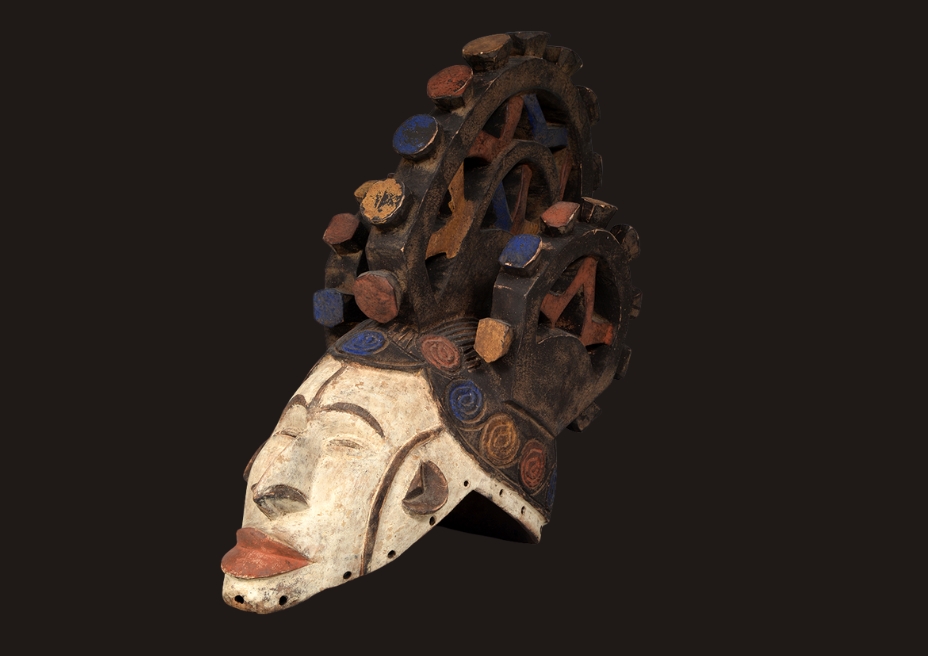
The visual power of the Agbogho Mmuo mask lies in its deliberate use of contrast and abstraction to signal the supernatural. Carved from lightweight wood, the face is typically covered in nzu (white chalk). In Igbo cosmology, white is not merely a color; it represents purity, sacredness, and the realm of the ancestors (mmuo). By rendering the maiden’s face stark white, the carver immediately communicates that this is a being from the spirit world, not a living person.
The features of the mask are characterized by a refined, delicate geometry:
- The Profile: Narrow, elongated noses and slightly parted lips present an ethereal expression of composure and serenity.
- The Markings: Fine, dark lines mimic uli, the traditional body artistry historically painted onto the skin using natural plant extracts. These marks represent refinement, status, and the community’s standards of care.
- The Crest: Crowning the mask is an incredibly detailed, high-crested hairstyle. These intricate carvings represent the elaborate, crested coiffures (nwanza) worn by young women during historic marriage coming-of-age ceremonies.
Paradox in Motion: The Masquerade Performance
The true complexity of the Agbogho Mmuo emerges during the annual harvest festivals and funerals of prominent elders, where the mask comes alive through performance.
In a striking cultural paradox, these representations of feminine grace, purity, and youth are performed exclusively by men.
The masquerader wears a skin-tight, brightly colored textile bodysuit adorned with complex embroidery, mirrors, and tassels. This costume is designed to exaggerate the physical grace of a young woman while protecting the performer’s identity.
Spirit World (Ancestors/Mmuo)
<--->
The Performer (Living/Initiated Man)
<--->
The Ideal (Maiden/Agbogho)
The performance itself is an athletic feat. The dancer moves with high-stepping, rhythmic, and fluid motions, mimicking the poise and elegance of an idealized maiden. Yet, beneath the delicate movements is a display of incredible stamina and strength required to balance the heavy, crested headpiece. Through this display, the community celebrates the vital contributions of women to the continuity of the lineage, while simultaneously enforcing moral codes; the maiden spirit embodies the virtue, modesty, and grace expected of young women entering adulthood.
Cultural Evolution and Global Influence
The Agbogho Mmuo is not a frozen relic of the past. It has continuously evolved, absorbing modern materials like plastic beads, synthetic yarns, and vibrant modern dyes into its costume design without losing its spiritual core.
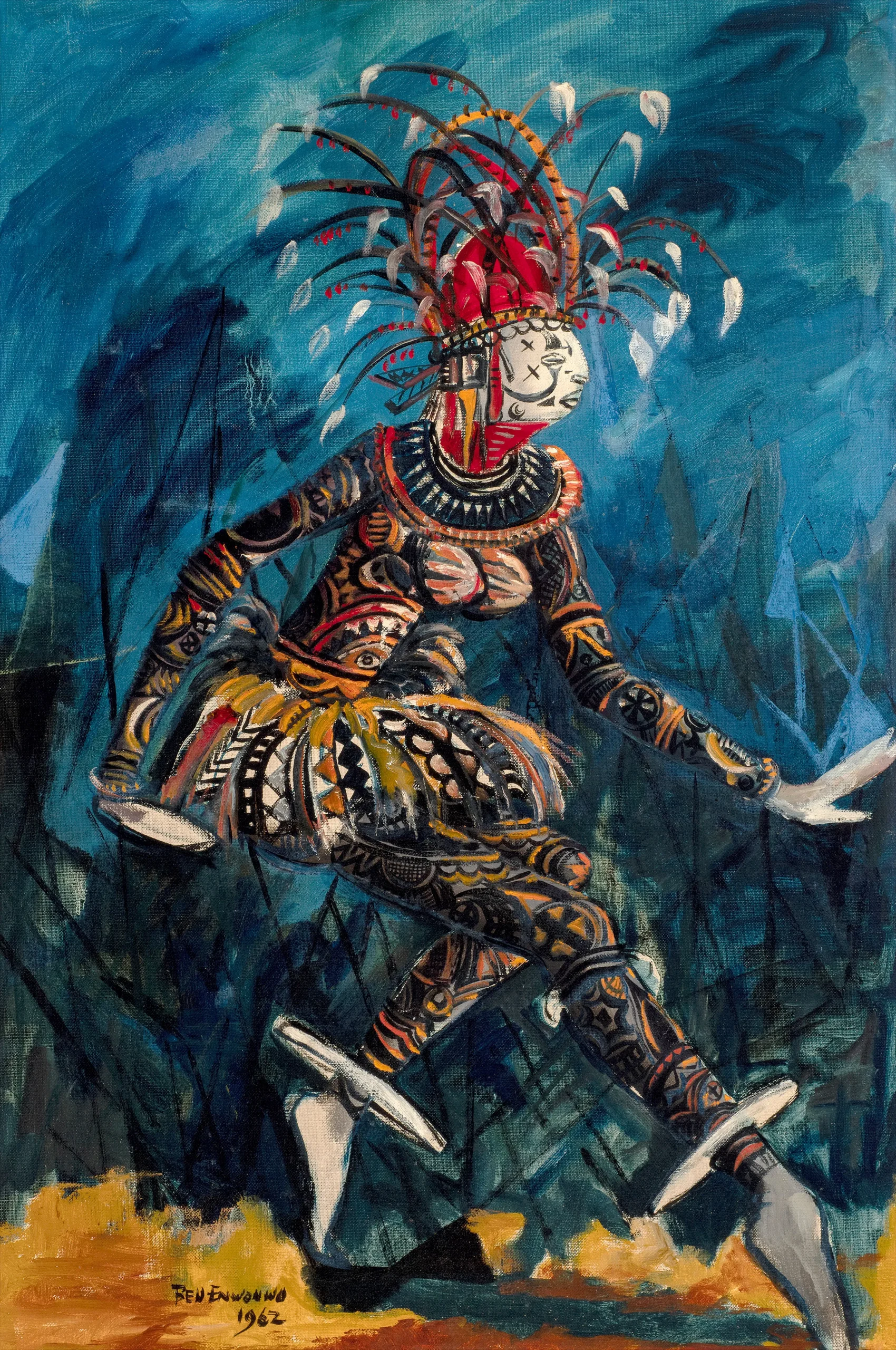
The Dancer (Agbogho Mmuo – Maiden Spirit Mask), 1962, Source: Ben Uri Gallery
Its striking visual language has also left a profound mark on modern global art. Celebrated 20th-century Nigerian artists, such as Ben Enwonwu, frequently drew inspiration from the fluid kinetics and form of the Maiden Spirit masquerade, translating its essence into world-renowned modern paintings and sculptures.
Conclusion
The Agbogho Mmuo is far more than an artistic artifact confined to history; it remains a dynamic, living institution that continues to anchor modern Igbo cultural identity. While its performance has adapted to contemporary materials and shifting social contexts, its core purpose, bridging the gap between the living community and the ancestral realm, endures across southeastern Nigeria.
Today, the traditions of the Maiden Spirit masquerade are preserved and practiced with immense pride across several key ancestral hubs in the region, particularly within the north-central Igboland of Anambra State.
Communities surrounding the historic Nri-Awka cultural axis, as well as the bustling riverside metropolis of Onitsha (where the performance is locally celebrated as Agbogho Mmwanu), serve as primary custodians of this heritage. Additionally, the vibrant masquerade cultures of Agulu, Igbo-Ukwu, and towns within the Idemili region regularly bring these ethereal spirits to life during major seasonal festivals, funerals of esteemed elders, and modern cultural celebrations.
Through these sustained regional practices, the Agbogho Mmuo ensures that the delicate balance of Igbo philosophy, where ancestral reverence meets human artistic expression, continues to dance vibrantly into the future.
References
Adim, S. E. (2025). Masquerade institution in Igboland. Journal of Arts, Social Sciences and Development, 8(1), 94–101.
Curnow, K. (n.d.). Art in small-scale communities. In The Bright Continent: African Art History. Cleveland State University.
Ezeifeka, C. R. (2018). Gender stereotypes in selected Igbo proverbs. Context: Journal of New African Studies, 4(2), 99–112.
Madukasi, F. C. (2026). Investigating Mmanwu Oza-ebili for social control in the traditional society of Uli town. Association of Caribbean Journal of Ophthalmic Lasers (ACJOL) Proceedings, 315–326.
Ojogho Chidiebere is a cultural researcher and a Curator with the National Commission for Museums and Monuments,(NCMM) Abuja.