

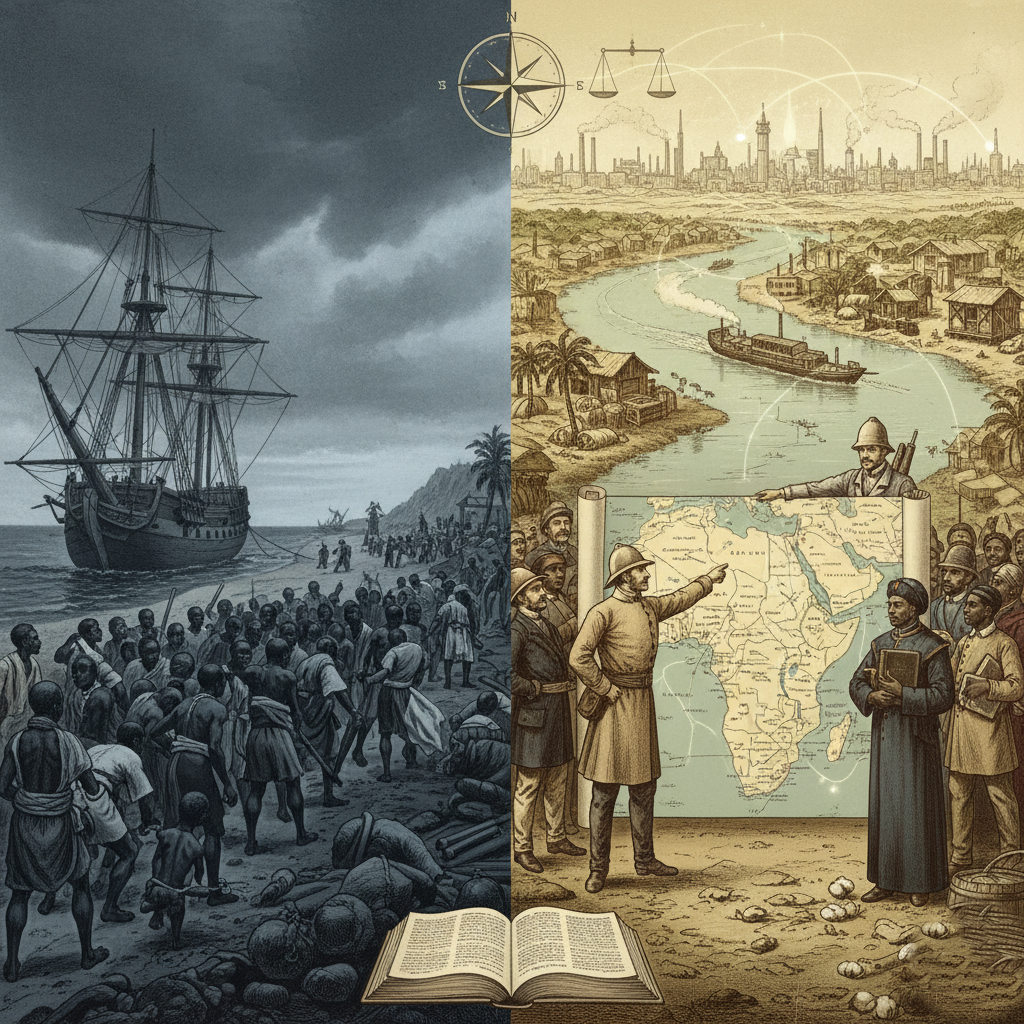
The abolition of the transatlantic slave trade in the early 19th century didn’t mark a moral turning point, but a strategic evolution of European intrusion and exploitation. Where once the primary commodity was human life exchanged in coastal forts, the new prize was the vast, resource-rich interior. To claim it, Europeans first had to know it. The era of the great African expeditions, ostensibly driven by curiosity and Christian duty, was in reality a systematic exercise in gathering the intelligence necessary for annexation and colonial rule.
1. The Shift to “Legitimate Trade” and the Nigerian Example 💰
The transition from the trade in human beings to what Europeans termed “legitimate trade” was driven by the Industrial Revolution’s insatiable demand for raw materials, replacing the demand for enslaved labor (Hobsbawm, 1968). This represented a change in the nature of the commodities sought, yet maintained a core exploitative structure based on extraction.
- New Primary Resources: The dramatic rise in the demand for palm oil essential for industrial lubricants and soap, rubber, cotton, and minerals was central to this shift (Lynn, 1997).
- Controlling the Source (The Nigerian Case): The territory that would become Nigeria quickly became the world’s leading exporter of palm oil, known as “Red Gold.” European traders sought to bypass the powerful African middlemen who controlled the coastal trade, leading to increased political intervention to secure direct access to the interior.
- Annexation as Economic Strategy: The annexation of Lagos in 1861 was justified by Britain under the pretext of stamping out persistent slave trading. In reality, it secured a vital port for the lucrative palm oil trade and established the first permanent British colonial foothold, a critical base for future expansion inland (Ajayi, 1965).
2. The Missionary Vanguard, European Intrusion, and Exploration’s Dual Purpose ✝️
The desire for new resources required new knowledge of the interior, paving the way for further European intrusion. A wave of state-sponsored and private expeditions, often cloaked in scientific or humanitarian language, served the crucial purpose of gathering political and geographical intelligence for future annexation.
- The Missionary Scout: The first consistent European presence in the interior often belonged to Christian missionaries, such as those from the Church Missionary Society (CMS). By establishing schools and churches in places like Yorubaland, they introduced European values and languages, creating a new elite that was often alienated from traditional structures and eroding the authority of local chiefs (Ayandele, 1979). Their stations served as vital logistical hubs for subsequent explorers and administrators.
- The Cartographer’s Claim: European Geographical Societies funded explorers who were essentially acquiring actionable commercial data. They identified navigable waterways, located mineral deposits, and assessed agricultural potential. This geographical knowledge was immediately translated into territorial ambition.
- The Imperial Artery: The charting of the Niger River proved it could be an imperial highway, directly leading to the formation of the Royal Niger Company (a chartered company). These companies were granted vast territories and quasi-governmental powers by their home governments (Flint, 1960), using commercial leverage and military force to establish British protectorates over large regions.

3. Naval Patrols and the ‘Civilizing Mission’ ⚖️
The transition required both a moral justification for European intrusion and a military mechanism to enforce control, shifting power from the sea to the interior.
- Naval Pretext: The British Royal Navy’s West Africa Squadron, while enforcing abolition, frequently used its military authority to coerce coastal African states into accepting anti-slavery treaties. These treaties restricted local sovereignty and opened African economies up to further European demands, providing a crucial mechanism for extending political and military control.
- Justifying Intervention: The concept of the “Civilizing Mission” framed colonization not as an act of theft, but as an act of benevolent necessity. European powers used the existence of internal African slavery (which they had earlier exacerbated) as a pretext to claim they had a moral duty to impose order and “progress.” This narrative provided the necessary cover for the violence and exploitation inherent in the Scramble for Africa.
- From Informal to Formal Control: The culmination of these methods was the Berlin Conference (1884-1885). Here, European powers formally laid out the rules for the partition of Africa, shifting the basis of colonial claim from coastal trade to “effective occupation” (Pakenham, 1991). This event solidified the systematic transition from slave commerce to formal colonial rule.
Conclusion: The Enduring Legacy of the Systematic Shift 🌍
The transition from the transatlantic slave trade to formal colonization was not a moral turning point, but a strategic evolution of European intrusion and exploitation. The era of exploration, missionary expansion, and geographical discovery effectively served as the intelligence-gathering phase of the imperial project. By utilizing the missionary as a scout, the mapmaker as a corporate agent, and abolition as a moral justification, European powers systematically engineered a transition from a chaotic, coastal commerce in human bodies to an organized, interior-based extraction of raw materials.
This shift, perfected in regions like Nigeria with the establishment of legitimate trade and the use of chartered companies, allowed Europe to maintain and deepen its economic dependency on Africa without violating new anti-slavery laws. The ultimate legacy is that the knowledge gathered in the mid-19th century of rivers, resources, and local political weaknesses became the foundational blueprint used to carve up the continent at the Berlin Conference. The result was a century of political subjugation and economic underdevelopment whose enduring structures continue to shape the global political economy today. The history of exploration, therefore, is ultimately the history of preparation for conquest.
References
Ajayi, J. F. A. (1965). Christian Missions in Nigeria 1841–1891: The Making of an Educational Elite. Longmans.
Ayandele, E. A. (1979). The Missionary Impact on Modern Nigeria, 1842-1914: A Political and Social Analysis. Longman.
Flint, J. E. (1960). Sir George Goldie and the Making of Nigeria. Oxford University Press.
Hobsbawm, E. J. (1968). Industry and Empire: The Making of Modern English Society, Vol. 2: 1750 to the Present Day. Pantheon Books.
Lynn, M. (1997). Commerce and Economic Change in West Africa: The Palm Oil Trade in the Nineteenth Century. Cambridge University Press.
Pakenham, T. (1991). The Scramble for Africa: White Man’s Conquest of the Dark Continent from 1876 to 1912. Random House.
Wikipedia. (n.d.). Lagos Treaty of Cession.