
September 16, 2025
In the rolling green heart of Imo State, where morning mist clings to red-earth compounds and the rhythmic thud of wooden mortars anchors the day, there exists a conviction older than the arrival of the cross or the records of the crown. It is the unwavering belief that life is not a straight line, but a circle.
To the people of Mbaise and Obowo, reincarnation—Ilo Uwa—is not a dusty myth or a fireside story. It is a lived reality, a spiritual compass, and the lens through which they view the mysteries of birth, death, and homecoming.
A World of Ancestral Fingerprints
In these communities, childbirth is viewed as more than a biological event; it is a return. A newborn is not a stranger, but a relative finding their way back to the family hearth.
Families watch for signs with the precision of scholars. A birthmark in a peculiar place, a toddler’s inexplicable habit, a dream during pregnancy, or even the child’s reaction to a specific person—all are read like omens. When the elders gather, the whisper is always the same:
“E nwere onye lọtara” — Someone has come back.
These “ancestral fingerprints” are undeniable to the locals. A boy born with a scar identical to his late uncle’s injury, or a little girl who instinctively reaches for the specific weaving loom of a long-dead grandmother, are not seen as coincidences. They are proof of a soul resuming its journey.
Mbaise: The Continuum of Loyalty
Mbaise is a land defined by a fierce ancestral consciousness. Here, reincarnation is treated as a practical extension of family loyalty.
In the town of Ahiara, locals still speak of a woman whose late mother promised in a dream, “I will return through you.” Months later, her daughter was born with a mole mirroring the grandmother’s exactly. As the child grew, she refused modern beds, insisting on sleeping only on the old woman’s traditional mat. In Mbaise, these children are often greeted with knowing nods: “He has come back to finish his work.”
Obowo: A Tradition Quietly Preserved
In Obowo, where riverine roots run deep, Ilo Uwa persists with a quiet resilience. While decades of Pentecostal influence have pushed the practice into the private corners of the home, the belief remains unshaken.
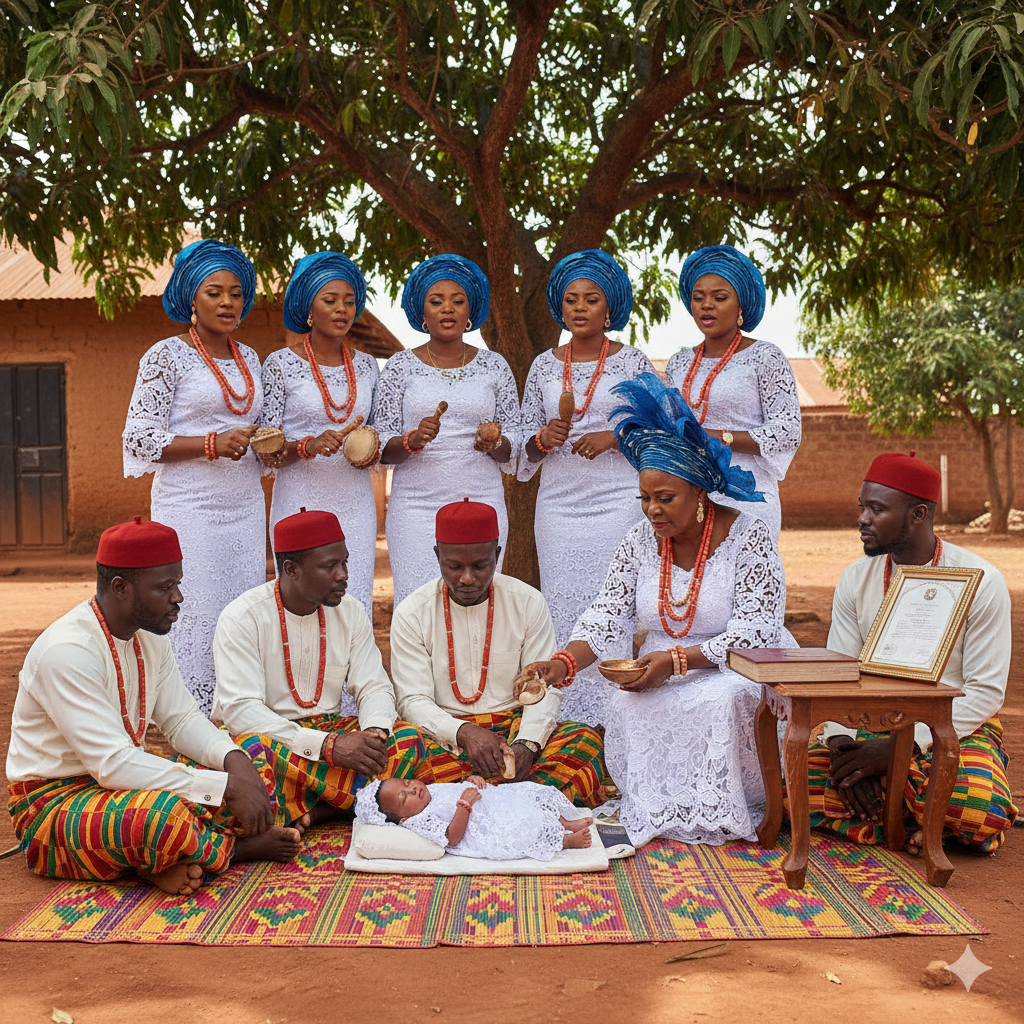
In Umuariam, an infant was recently born with a dark pigmentation around her wrist, mirroring the traditional bead marks of a deceased matriarch. On naming day, the family balanced two worlds: they gave her the ancestor’s name, Ngozichukwukama, and performed a dawn cleansing rite with herbal baths and libations. By afternoon, the same child was at a Catholic altar for baptism—two spiritual identities woven together without conflict.
The Sacred Rituals of Recognition
When a soul is believed to have returned, several rites often follow to ensure a smooth transition:
- Consultation with a Dibia: A traditional diviner is often sought to identify the returning soul and determine if there are past-life burdens to address.
- Herbal Cleansing: A symbolic washing using river water and sacred leaves to “cool” the soul from its journey.
- Naming as Restoration: The child is given the ancestor’s name not just for honor, but to restore their place in the lineage.
The Cross and the Circle: A Clash of Faiths
The arrival of Christianity created a complex spiritual landscape. In Mbaise, Catholicism and tradition have reached a quiet truce; many families baptize their children in the church while maintaining ancestral rites at home.
Pentecostalism, particularly in Obowo, takes a firmer stance, often labeling reincarnation as “ancestral bondage.” Yet, even here, the old ways endure. Grandmothers, the keepers of memory, often lead these rituals in secret, ensuring that the ancient connection between the living and the dead is never truly severed.
Modern Times, Ancient Souls
Ilo Uwa has adapted to the 21st century. Today:
- Mothers record “visitation dreams” on smartphones.
- The Diaspora consults elders via video call to confirm a child’s spiritual lineage.
- Modern parents give their children “English” names for the world, but ancestral names for the soul.
As the elders say: “Spiritual things do not disappear just because we stop talking about them.” In Mbaise, they believe that life circulates; in Obowo, they know that death is merely the road that leads back home.
Tales of the Returned
- The Drummer (Mbaise): A two-year-old in Oru who played the Ogene with the professional mastery of a grandfather he never met.
- The Inherited Wound (Obowo): A baby born with a scar on the same leg where her uncle suffered a fatal injury; her first spoken word was his name.
- The Widow’s Visitor (Mbaise): A toddler who insisted on sitting in a specific patriarch’s chair and referred to the widowed matriarch as “my wife.”
- The Double Naming: A modern compromise where one name satisfies the church, and the other honors the bloodline.
Why the Circle Endures
Reincarnation survives not as a rejection of modern faith, but as a bridge. it explains the unexplainable, heals the sting of grief by transforming loss into return, and anchors a person’s identity in a community that spans generations.
A people who remember their dead so deeply cannot believe they are ever truly gone. In Mbaise and Obowo, the story doesn’t end at the grave—it simply waits for the next cradle.
Ojogho Chidiebere is a cultural researcher and a Curator with the National Commission for Museums and Monuments,(NCMM) Abuja.