
September 25, 2025
In the rolling hills and dense rainforests of southern Nigeria, three ancient centers of civilization, Ife, Benin, and Owo, forged some of the most sophisticated artistic traditions in human history. To the untrained eye, their brilliant brass castings, expressive terracottas, and delicate ivory carvings might look like separate, isolated phenomena. In reality, they are deeply interconnected, bound together by centuries of migration, shared royal bloodlines, and a fluid cultural dialogue.
The Historical Tapestry: How the Kingdoms Interwove
You cannot fully appreciate the physical beauty of these artifacts without understanding how closely intertwined these three kingdoms were. They were not merely trading neighbors; they shared a profound ancestral DNA.
The Source: Ile-Ife
Ile-Ife is universally recognized as the spiritual cradle of the Yoruba people. According to myth, it was the site of creation itself. By the 11th century, Ife had grown into a powerful, sacred metropolis. Its spiritual authority radiated outward, casting a long shadow over the political landscapes of neighboring states.
The Dynastic Link: Ife and Benin
The connection between Ife and the Kingdom of Benin, an Edo-speaking empire to the southeast, is cemented in royal lineage. According to both Yoruba and Edo oral histories, the people of Benin faced a political crisis and requested a ruler from the spiritual king (the Ooni) of Ife. The Ooni sent his son, the warrior-prince Oranmiyan.
While Oranmiyan found the politics of Benin difficult to manage and ultimately returned home, his son with an Edo princess became Eweka I, the very first Oba (king) of Benin’s current imperial dynasty. Because of this dynastic marriage, early Benin kings looked to Ife as their ancestral home. For centuries, when an Oba of Benin died, his remains, or at least symbolic portions of them, were sent back to Ife for holy burial, and Ife master metalsmiths were dispatched to Benin to cast memorial heads for the royal altars.
The Bridge: Owo
Positioned geographically right between the Yoruba heartland of Ife and the expanding imperial boundaries of Benin, the kingdom of Owo became the ultimate cultural crossroads. Owo was a Yoruba kingdom, but its proximity to Benin meant it was constantly navigating the political and military might of the Edo empire.
Over the centuries, Owo acted like a cultural sponge. It maintained its deep, spiritual Yoruba roots tracing back to Ife, while simultaneously adopting the courtly etiquette, architectural styles, and militaristic regalia of the Benin palace. This dual identity is vividly alive in its art.
Physical Features and Style: Visual Similarities
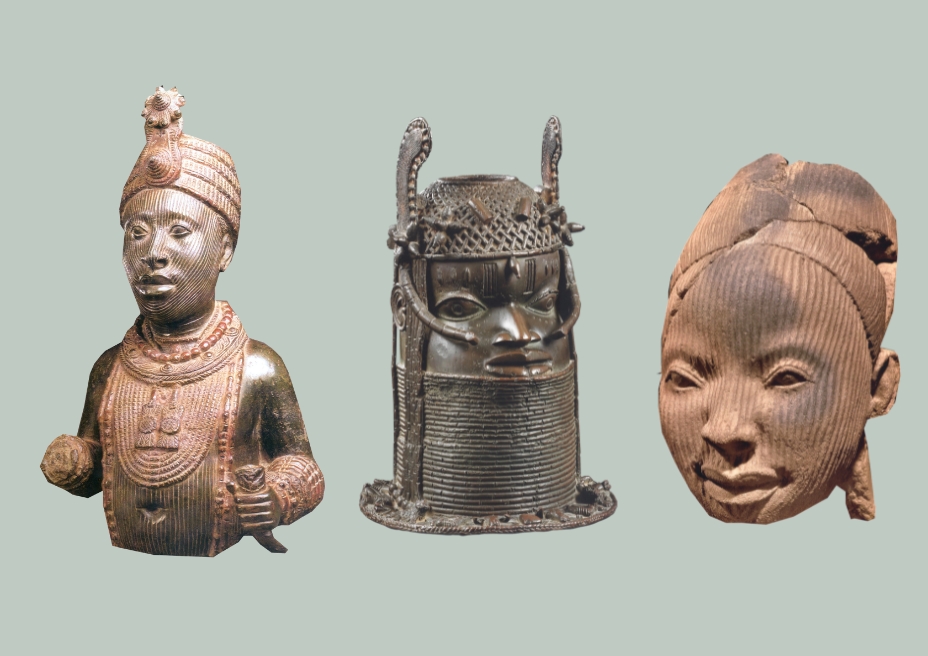
Despite their distinct artistic traditions, Ife, Benin, and Owo artworks share several visual similarities that reflect their historical and cultural connections. All three traditions emphasize human figures, especially representations of kings, nobles, and important individuals. They display exceptional craftsmanship in bronze, brass, ivory, and terracotta, demonstrating advanced artistic and technological skills.
Ife’s naturalistic style influenced both Benin and Owo art, particularly in the realistic modeling of faces and attention to detail. Owo artworks combine Ife’s lifelike features with Benin’s elaborate decorative elements, while Benin art shares with Ife and Owo a focus on royal authority and ceremonial symbolism. The use of intricate ornamentation, royal regalia, scarification marks, and idealized portrayals of elite individuals further highlights the visual and cultural links among these three artistic traditions.
Ife Artifacts: Serene Naturalism
The art of Ife (flourishing between the 12th and 15th centuries) shocked the Western world when it was first unearthed. Its realism was so astonishingly lifelike that early European collectors erroneously assumed it had to be the work of lost Greeks or Atlanteans, a deeply biased view that ignored the highly localized, indigenous mastery of the lost-wax casting technique.
- Materials: Primarily terracotta, pure copper, and heavily leaded brass.
- Facial Features: Ife heads are famous for their quiet, breathing naturalism. Faces are rendered with flawless, flesh-like curves, delicate lips, and almonds eyes. Many heads are covered in fine, perfectly parallel vertical lines, which represent royal scarification or the shadows cast by beaded veils.
- Proportions and Philosophy: Ife art prioritizes the ori inu (the inner, spiritual head). The expressions are universally serene, calm, and untroubled by age or emotion, capturing the semi-divine, cool composure expected of an Ooni.
Benin Arts: Imperial Proportions and Power
As Benin grew into a massive military empire from the 15th to the 19th centuries, its art shifted away from Ife’s quiet individualism toward a style that loudly celebrated the power, wealth, and history of the state.
- Materials: Heavy, thick-cast brass and meticulously carved elephant ivory.
- Visual Style and Regalia: Unlike the smooth, naked faces of Ife, Benin art is heavily textured and laden with detail. Figures are draped in dense, stacked rows of royal coral beads that cover the neck up to the jawline. The faces feature highly stylized, wide eyes and strong, blocky features.
- Hieratic Scale: In Benin’s famous bronze wall plaques, artists used “hieratic scale”, the more important you are, the bigger you are drawn. The Oba is always depicted as a massive central figure, flanked by much smaller attendants and foreign traders. The heads of Benin figures are also intentionally enlarged, taking up roughly one-third of the body’s total height, to emphasize the center of divine command and intellect.
Owo Arts: The Fluid Synthesis
Archaeological digs in Owo (especially at the site of Igbo’Laja) reveal an art style that refuses to be boxed into just one category. Owo artists took the technical brilliance of both empires and fused them into something highly expressive and theatrical.
- Materials: Renowned for exceptionally expressive terracottas and masterfully intricate ivory work.
- The Hybrid Aesthetic: Look closely at an Owo sculpture, and you will see a fascinating tug-of-war. The roundness of the cheeks, the delicate modeling of the eyes, and the peaceful expressions often point right back to the classical heritage of Ife. However, the themes, such as human sacrifices, animals holding logs, and chiefs dressed in heavy, layered ceremonial skirts, are pulled directly from the court arts of Benin.
- Emotional Intensity: While Ife is calm and Benin is stoic, Owo art often captures raw emotion and action. Terracotta fragments from Owo display faces with wide-open, shouting mouths, bared teeth, and distorted muscles, capturing moments of intense ritual drama that the other two kingdoms rarely depicted.
A Continuous Conversation
Ultimately, comparing Ife, Benin, and Owo reminds us that culture is fluid. Ife provided the foundational, spiritual vocabulary of naturalism and metallurgy. Benin took those tools and built a monumental, historic archive of imperial power. Owo, sitting at the geographical heart of the trade routes, blended the two, proving that artistic boundaries are just as porous as political ones. They represent a single, massive creative ecosystem that remains a pinnacle of global art history.
References
Blackmun, B. W. (1984). The arts of Africa: The Benin kingdom. University of California Press.
Blier, S. P. (1985). Kings, crowns, and rights of succession: Obalufon arts at Ife and other Yoruba centers. The Art Bulletin, 67(3), 383–401. https://doi.org/10.1080/00043079.1985.10788279
Blier, S. P. (2012). Art in ancient Ife, birthplace of the Yoruba. African Arts, 45(4), 70–85. https://doi.org/10.1162/afar_a_00029
Drewal, H. J., Pemberton III, J., & Abiodun, R. (1989). Yoruba: Nine centuries of African art and thought. Harry N. Abrams.
Evans, T. L. (2023). A copper alloy head count: Contextualising and accounting for the Wúnmọníjẹ̀ Compound discoveries of Ilé-Ifẹ̀, Nigeria. Afrique : Archéologie et Arts, 19, 67–100. https://doi.org/10.4000/aaa.4918
Eyo, E. (1977). Two thousand years of Nigerian art. Federal Department of Antiquities.
Fagg, W., & Underwood, L. (1949). Nigerian images. Faber and Faber.
Lawal, B. (2012). Yoruba art and language: Seeking the African in African art. Cambridge University Press.
NCMM. (2011). Guide to Nigerian museums and monuments. National Commission for Museums and Monuments.
Plankensteiner, B. (Ed.). (2007). Benin: Kings and rituals—Court arts from Nigeria. Snoeck Publishers.
Poynor, R. (2015). The art of Owo. In K. V. G. Ajayi & T. Falola (Eds.), Yoruba culture and tradition (pp. 145–160). Pan-African University Press.
Poynor, R., & Onibode, B. (2024). I hold in my hand…: Prestige, rank, and power. African Arts, 57(3), 44–65. https://doi.org/10.1162/afar_a_00775
Roth, L., Chouin, G., & Ogunfolakan, A. (2021). Lost in space? Reconstructing Frank Willett’s excavations at Ita Yemoo, Ile-Ife, Nigeria: Rescue excavations (1957–1958) and trench XIV (1962–1963). Afrique : Archéologie et Arts, 17, 77–114. https://doi.org/10.4000/aaa.3328
Willett, F. (1967). Ife in the history of West African sculpture. Thames and Hudson.
Willett, F. (2004). African art: An introduction. Oxford University Press.
Ojogho Chidiebere is a cultural researcher and a Curator with the National Commission for Museums and Monuments,(NCMM) Abuja.