
June 6, 2025
“In Benin court art, bronze and ivory were never merely materials of decoration; they were instruments through which history, kingship, spirituality, and memory were preserved for generations.”
Across the history of Africa, few artistic traditions have achieved the level of technical sophistication, symbolism, and historical depth found in the royal art of the ancient Benin Kingdom. Long before modern historical documentation became widespread, Benin court art functioned as a visual archive through which political authority, spiritual beliefs, royal achievements, warfare, diplomacy, and ancestral memory were preserved. Cast in bronze, carved in ivory, or fashioned in wood and iron, these objects were never merely decorative creations. They formed part of a highly organized court system in which art operated as a language of power, ritual, identity, and governance.
Today, Benin court art remains one of the most internationally recognized artistic traditions from Africa. Yet public attention often focuses primarily on the famous “Benin Bronzes” as looted artworks scattered across foreign museums. While the debates surrounding restitution remain important, the deeper meanings embedded within these objects are sometimes overlooked. Each plaque, altar bell, commemorative head, ceremonial sword, or ivory tusk was created within a larger philosophical and political structure that defined the Benin Kingdom between the fourteenth and seventeenth centuries.
At the centre of this artistic tradition stood the Ọba of Benin, regarded not simply as a political ruler but as a sacred monarch whose authority connected the physical and spiritual worlds. Benin court art repeatedly reinforced this sacred kingship through symbols of strength, divine legitimacy, ancestral continuity, and ritual authority. The royal palace itself functioned as both political headquarters and sacred space, where art objects were used to communicate royal ideology and preserve dynastic memory.
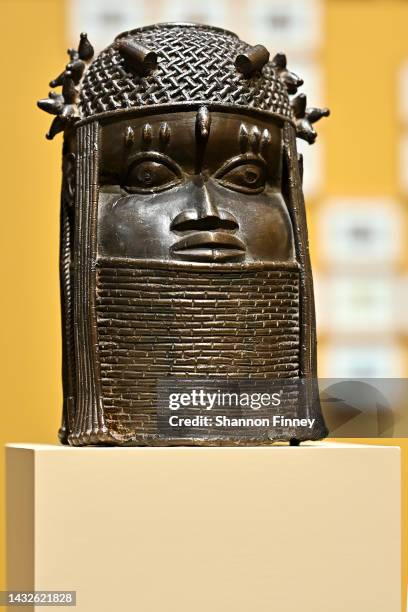
Among the most significant objects within this tradition are the commemorative heads known as Uhunmwun-Elao. These bronze memorial heads were commissioned by newly crowned rulers to honour deceased predecessors and were placed on ancestral altars within the palace. More than portraits, these heads served as spiritual links between the reigning Ọba and the royal ancestors. Their placement on altars reinforced the belief that kingship in Benin existed within an unbroken ancestral continuum.
In many examples, carved ivory tusks known as Aken’niElao were inserted into openings at the top of these commemorative heads. These tusks, richly decorated with relief carvings of royal activities, warriors, attendants, animals, and ritual scenes, functioned as historical records of the kingdom. The elephant itself symbolized strength, wisdom, permanence, and royal authority. Together, the bronze head and ivory tusk formed one of the most powerful altar assemblages within the Benin court.
The importance of ancestral reverence is also visible in the Ukhurhe, the wooden rattle staff associated with ancestral altars. Often topped with carved heads and containing internal clappers, these staffs embodied the continuing presence and authority of ancestors, former rulers, and important figures within the kingdom. During rituals, the sound produced by the staff symbolically connected the living with the ancestral realm.
Closely related to these ritual practices were the bronze Egogo altar bells. Bells occupied an essential place in Benin ceremonial life. Their ringing summoned ancestral spirits, announced offerings, and initiated communication between worshippers and the spiritual world. Far from simple musical instruments, altar bells represented spiritual activation and sacred dialogue.
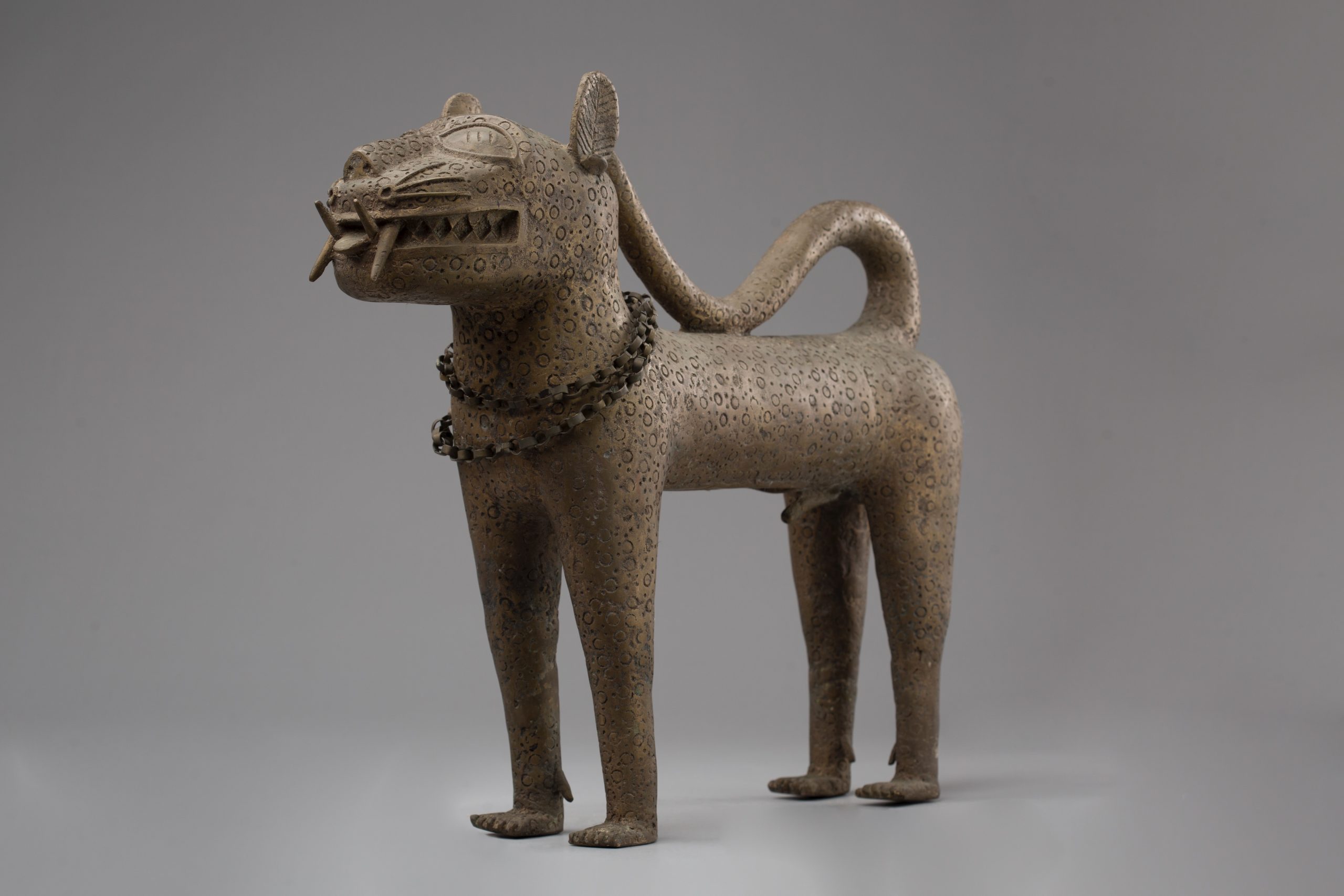
The concept of sacred kingship was further reinforced through animal symbolism, particularly the leopard known as Ẹkpẹn. Leopard figures and leopard-aquamaniles appeared frequently in Benin court art because the leopard symbolized courage, wisdom, ferocity, and controlled power—qualities associated directly with the Ọba. In Benin thought, the leopard was regarded as the “king of the forest,” while the Ọba remained the “king of the home.” The relationship between both symbols reinforced the ruler’s supreme authority.
Bronze leopard figures were often produced in pairs and placed on royal altars as spiritual guardians. Leopard-shaped aquamaniles were also used in ceremonial handwashing rituals connected to palace traditions. These ritual vessels demonstrate how functionality and symbolism merged seamlessly within Benin court art.
Another recurring motif in Benin royal imagery is the mudfish. Seen prominently in bronze plaques and stools such as the Erhe mudfish stool, the mudfish symbolized the Ọba’s ability to exist simultaneously within the human and spiritual realms. Because mudfish survive both in water and on land, they became metaphors for supernatural adaptability and divine kingship. In several bronze plaques, the Ọba’s legs is represented with mudfish, emphasizing his spiritual authority and connection to Olokun, the deity associated with the sea, wealth, and cosmic power.
Benin plaques themselves remain among the most historically significant artistic achievements of the kingdom. Produced largely from the reign of Oba Ewuare in the fifteenth century onward, these plaques decorated palace pillars and documented royal ceremonies, military campaigns, diplomatic encounters, court hierarchy, and spiritual beliefs. They functioned as visual historical records, communicating royal legitimacy and preserving institutional memory.
The plaques also reveal the complexity of Benin’s interactions with foreign societies, particularly the Portuguese. Several objects, including ivory containers and bronze helmets, depict Portuguese soldiers and European-inspired forms. These representations reflect early diplomatic and commercial contact between Benin and Europe from the fifteenth century onward. However, Benin artists did not merely imitate foreign imagery; they transformed external influences into distinctly Benin artistic expressions.
One example is the ornate bronze Uru or lidded ewer. Though influenced by foreign vessel forms, the object incorporates highly symbolic Benin imagery including a seated Ọba, snake-shaped handle, monkey spout, and human-leg supports. The monkey motif, uncommon in Benin art, is associated with warfare preparation, while the snake symbolizes supernatural power and ritual expertise. The object therefore combines imported formal inspiration with deeply localized symbolic meaning.
Military power and ceremonial authority were equally important within the visual language of Benin court art. The ceremonial swords known as Eben and Ada served not only as royal regalia but also as symbols of political legitimacy and divine authority. The Eben, with its broad leaf-shaped blade and openwork decoration, was used by high-ranking chiefs and the Ọba during festivals and palace rituals. The curved Ada represented supreme authority and was closely associated with royal power and the right to rule.
The support system surrounding the monarchy also appears repeatedly in Benin art. Bronze waist pendants and pendant plaques often depict the Ọba supported physically by chiefs standing beside him. This imagery symbolized the collective structure required to sustain kingship and maintain political stability within the kingdom. It reflected an understanding that authority operated within a broader court hierarchy rather than through isolated power alone.
Female authority also occupies a major place within Benin court traditions, particularly through representations of the Queen Mother or Iyọba. The commemorative heads of Queen Idia remain among the most celebrated examples of African art globally. Queen Idia played a significant political and spiritual role during the reign of Oba Esigie and became immortalized through ivory portrait masks and memorial heads commissioned after her death.
The famous ivory pendant mask of Queen Idia, known as Iya-Oba, later became the emblem of FESTAC ’77, symbolizing African cultural pride and artistic excellence. Adorned with coral beads and intricate carvings, the mask reflects the elevated status of the Queen Mother within Benin political structure. Its continued recognition today demonstrates the enduring cultural influence of Benin court art far beyond its original historical context.
Equally important are ritual objects associated with shrine practices and spiritual protection. The bronze rooster or Okpa, commonly associated with Queen Mother altars, symbolized vigilance and guardianship. The Akhe-Osun ritual pot, decorated with relief imagery of snakes swallowing frogs, reflected beliefs surrounding spiritual attack, ritual medicine, and supernatural power within palace shrines.
Benin court art also preserved oral history and political memory through symbolic storytelling. The famous “Bird of Prophecy” commemorates the legendary account of Oba Esigie’s military victory despite warnings of defeat. According to tradition, the Ọba declared that success belonged to those who refused to surrender to fear and negative prophecy. The casting of this bird in bronze transformed oral tradition into permanent visual memory.
Perhaps what distinguishes Benin court art most significantly is its integration of aesthetics, governance, spirituality, and historical documentation into a unified artistic system. Objects were rarely isolated from function. Art served ritual purposes, reinforced political authority, documented historical events, preserved ancestral continuity, and communicated cosmological beliefs simultaneously.
The technical achievements of Benin bronze casters further underline the sophistication of this artistic tradition. Using the lost-wax casting technique, Benin guild artists produced highly detailed sculptures and plaques centuries before many European societies fully appreciated African metallurgical expertise. The precision of surface decoration, anatomical representation, and symbolic composition demonstrates advanced artistic specialization supported by royal patronage.
Yet the history of Benin court art cannot be separated from the events of 1897, when British forces invaded Benin during the punitive expedition, looting thousands of royal objects from the palace. These artworks were subsequently dispersed across museums and private collections throughout Europe and North America. Their removal not only displaced physical objects but also disrupted cultural memory and institutional continuity within the kingdom.
Today, ongoing restitution efforts continue to reshape global conversations surrounding ownership, ethics, and cultural heritage. Some Benin objects have gradually been returned to Nigeria, while others remain subjects of negotiation. However, beyond the politics of restitution lies a deeper issue: the need to understand these objects not simply as artworks, but as living records of a highly organized civilization with sophisticated systems of governance, spirituality, diplomacy, and artistic production.
Benin court art remains one of Africa’s most important contributions to global cultural history. Its objects speak not only through their beauty but through the political, spiritual, and historical knowledge embedded within them. Every bronze plaque, commemorative head, altar bell, leopard figure, or ivory tusk carries evidence of a kingdom that understood art as a tool for preserving memory, legitimizing authority, and connecting generations. In many ways, these objects continue to perform that function today. They remain active witnesses to history, cultural identity, artistic excellence, and the enduring intellectual legacy of the Benin Kingdom.
Nwaokobia Stephanie Chinonso writes from National Museum Lagos