

Preamble
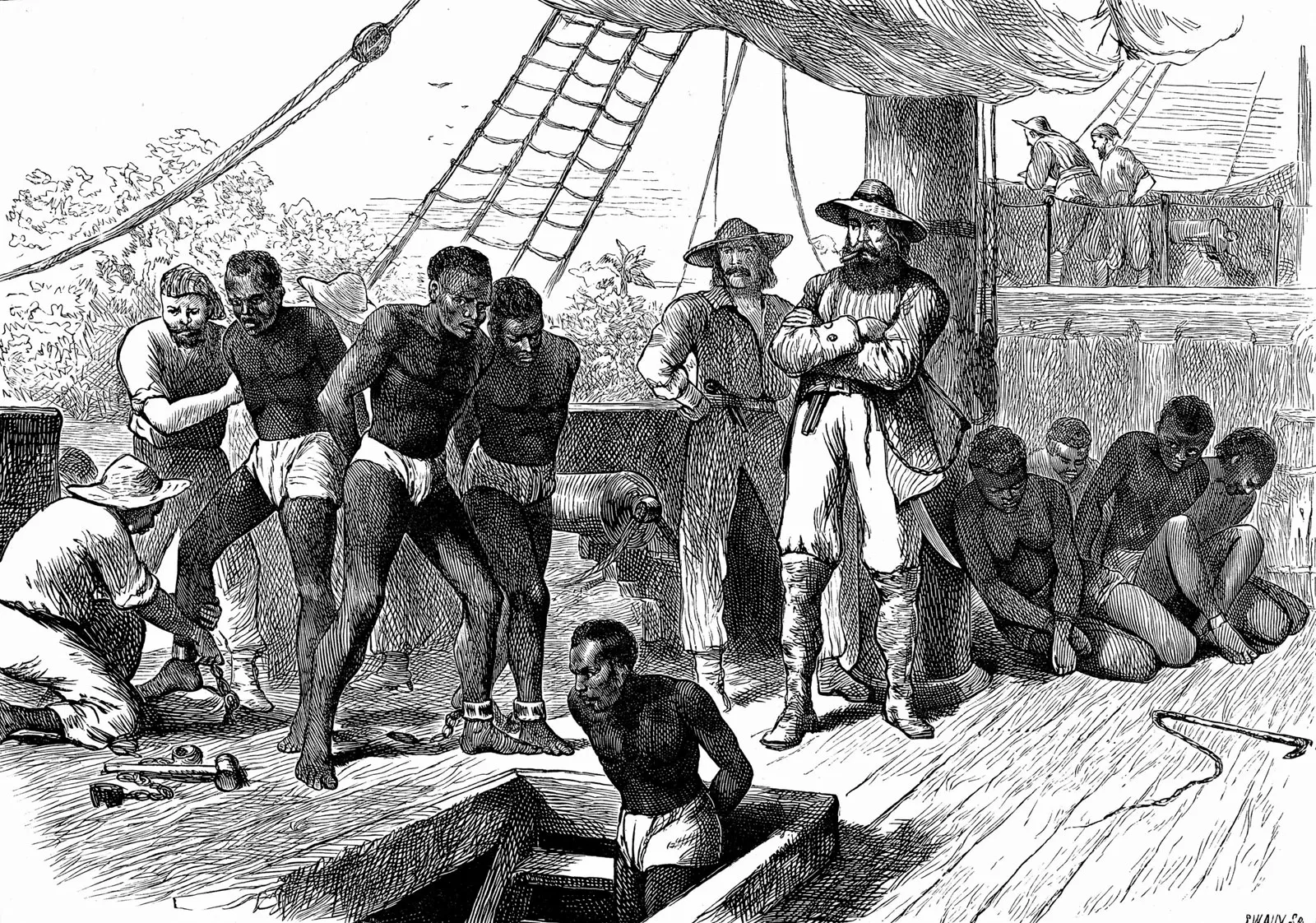
The Transatlantic Slave Trade, driven by insatiable European demand for labor in the Americas, fundamentally rewired the political landscape of West Africa. While the sheer scale of European demand was the engine, the trade’s mechanics operated by African rulers and traders created a feedback loop that concentrated immense wealth and military power along the coast, resulting in the rise of powerful, often absolutist, states and a deep-seated coastal dependency.
The Pre-Colonial Logic of Slavery
To understand the distortion, one must first recognize the “initial internal logic” of African slavery. Before the European arrival, slavery and servitude were established practices across the continent, but they often differed significantly from the chattel slavery that would evolve in the Americas.1
- Kinship and Integration: In many traditional African societies, a person might become enslaved through war, debt, or crime. However, this status was frequently not permanent or inheritable. The enslaved person was often seen as an “unaffiliated” individual who could, over time, be integrated into the captor’s family or clan. They held rights and their descendants could achieve full freedom. It was often a status tied to kinship and social absorption, not to dehumanized, perpetual chattel property.
- A Status, Not an Commodity: This system treated the enslaved as a form of social capital and labor, not as a fungible, exportable commodity. The scale and motive were localized.
The arrival of European ships, laden with firearms, textiles, and alcohol, seeking millions of captives, utterly shattered this logic. The economic incentive became too powerful to resist, transforming people from a means of social integration into the most valuable item of international commerce.
👑 The Rise of Absolutist Trading States
The influx of wealth and, crucially, European firearms, provided the necessary ingredients for a radical shift in political organization. The states that mastered the trade-like Dahomey (in present-day Benin) and the Asante Confederacy (in present-day Ghana) grew exponentially in power and scope.
1. The Firearms-for-Captives Cycle
The trade created a vicious cycle of violence and centralization:
- Centralized Military Power: European muskets and gunpowder were essential for successful large-scale slave raiding. These items were expensive and could only be acquired by the coastal states that controlled the trading forts. This monopolization of advanced weaponry gave the central ruler an overwhelming advantage over internal rivals, village chiefs, and non-coastal communities.
- The Need for War: To secure more firearms, rulers needed to sell more captives. This created a permanent impetus for war and raiding into the interior. The state’s primary function shifted from governance and maintenance of order to systematic warfare and human extraction. The state itself became an engine of militarized capture.
2. Concentration of Wealth and Authority
The massive profits from the slave trade bypassed the traditional, decentralized checks on power. Instead, wealth flowed directly into the royal treasuries of the coastal kings.
- Dahomey’s Transformation: Dahomey is a prime example. Its kings built a highly centralized, militaristic structure, famously including the all-female military corps known as the Dahomey Amazons, explicitly geared toward capturing slaves from surrounding regions. The king’s power became absolute, resting on the twin pillars of European guns and the wealth generated by the sale of human beings. Traditional checks by councils or local chiefs withered as the king controlled the single, most vital resource: the European trade.
This political transformation was a direct distortion. The new states weren’t just powerful; they were designed and maintained by the economic imperative of the European market, creating a form of militarized absolutism.
⚓ Entrenching Coastal Dependency
The final, devastating legacy was the creation of a fragile coastal dependency.
- Loss of Economic Diversity: The slave trade became the single most profitable economic activity. Kingdoms neglected traditional industries, agriculture, and internal trade routes in favor of the easier, higher returns from human trafficking. This specialization left the states economically brittle and dependent on continued European trade.
- The Human Cost and Internal Fractures: By constantly warring with and destabilizing their neighbors, the coastal states eliminated potential trading partners and created permanent, internal zones of conflict. The interior, constantly raided for captives, was systematically impoverished and depopulated, thereby deepening the rift between the coast and the hinterland.
When European abolition movements gained traction in the 19th century, the coastal kingdoms, having sacrificed economic diversity and internal stability for the slave trade, were left unable to pivot. They were structurally reliant on a trade that was being outlawed, weakening them just as European powers began to transition from commerce to conquest.
😔 The Human Toll: Beyond Political Science
The political structures that emerged were cold engines of commerce, yet we must not lose sight of the human tragedy they facilitated. The absolute monarchs, empowered by foreign weapons, ensured that the most valuable commodity was not gold or ivory, but the flesh and future of their own people and neighbors.
- The Traders’ Dilemma: African rulers and traders were not monolithic villains; they were actors operating under immense economic pressure. They faced a terrible trade-off: participate in the slave trade to acquire the weapons necessary for defense and expansion, or risk being overwhelmed and having their own people sold into slavery by a better-armed neighbor. This is the ultimate, tragic humanization of the dilemma, a desperate choice that perpetuated the system.
In the end, European demand did more than just consume lives; it corrupted and centralized power structures, transformed social status into commodity, and engineered a profound political and economic dependency that laid the groundwork for the ensuing era of colonization. The “initial internal logic” of African kinship and integration was utterly annihilated by the immense, profit-driven demand for chattel property.
🇳🇬 The Nigerian Case Study: The Slave Trade’s Distorting Political Mirror
The region that is now Nigeria was one of the most heavily affected by the Transatlantic Slave Trade, particularly the coastal areas bordering the Bights of Benin and Biafra. European demand acted as a massive external shock that amplified existing political trends, created new militarized absolutisms, and severely destabilized entire empires and communities.
The Rise and Fall of the Oyo Empire
The Oyo Empire (Yoruba) in the southwest serves as a stark example of how European demand both fueled and ultimately undermined a centralized state.
- Absolutism via Firearms: Oyo was already a powerful savanna kingdom with a sophisticated political structure and a powerful cavalry. However, its involvement in the slave trade, which provided access to European firearms, allowed it to consolidate power and push its influence southward towards the coast to control the lucrative trade routes. By the 18th century, Oyo forced coastal states like the Kingdom of Dahomey into tributary status, ensuring its access to the vital ports (like Whydah, though outside modern Nigeria, it was key to the region’s slave exports).
- The Dependency Trap: The Empire’s economy and its Alaafin’s (King’s) political authority became increasingly reliant on the revenue generated by selling captives. This distorted the traditional internal logic of their state. The need for slaves to trade for guns, and then the use of those guns to acquire more captives, created a self-perpetuating cycle of violence and external dependency.
- Destabilization and Collapse: When the British began aggressively suppressing the slave trade in the early 19th century, Oyo’s main revenue stream collapsed. This economic shock, combined with internal political weakness and the rise of powerful sub-groups armed by the same trade (as well as pressure from the northern Sokoto Caliphate), led to a series of civil wars among the Yoruba. The once-mighty empire fragmented into warring city-states, paving the way for eventual colonial intervention.
The Coastal Trading City-States: Centralization and Fragmentation
In the Niger Delta and the Bight of Biafra, the trade fostered the rise of decentralized trading polities that rapidly centralized power among specific elites:
- The Delta City-States (e.g., Bonny, Calabar): These weren’t traditional empires but new, dynamic polities founded on maritime trade. Their political structures, often based on “House Systems,” became highly centralized and commercially focused. Power was wielded by the wealthy merchant elite (the heads of the Houses) who managed the entire supply chain of captives from the interior to the European ships.
- New Power Elites: The rise of these commercial oligarchies marginalized traditional authority and focused political energy purely on trade efficiency, demonstrating a swift, profit-driven absolutism over commerce.
- The Aro Confederacy (Igboland): Though not strictly a centralized state, the Aro Confederacy, centered around the Oracle known as Ibini Ukpabi (the Long Juju) developed a vast trading network that functioned as a major middleman for the slave trade in the interior of Eastern Nigeria. The Aro used their political and religious influence, often backed by military force and the threat of the Oracle, to procure and transport captives across a wide, otherwise politically fragmented region. This commercial power gave them an unprecedented level of control and influence, effectively creating a powerful, non-territorial, centralized economic system for human extraction.
💔 Annihilation of Internal Kinship Logic
The Nigerian case study provides a tragic answer to the question of whether the initial internal logic of African servitude survived: it did not.
- From Kinship to Commodity: In fragmented societies like the Igbo hinterland, where slavery was typically a non-permanent status and sometimes a punishment, the European demand for a perpetual, disposable labor force transformed the meaning of captivity. The sheer volume and value of the Atlantic trade made it profitable to sell neighbors, criminals, debtors, and, increasingly, people simply acquired through mercenary raiding.
- Dehumanization for Export: The focus shifted from local integration to mass export, which necessitated the total dehumanization of the captive. The economic pressure became the primary engine, overriding traditional social mechanisms that offered paths to freedom or integration.
The political structures whether the centralized cavalry state of Oyo or the commercial oligarchies of the Delta were corrupted and restructured by the necessity of acquiring and exporting human beings. This left the entire region politically fractured and economically dependent, setting the stage for the relatively easy conquest by European colonial powers in the 19th century.
References
- Akinjogbin, I. A. (1967). Dahomey and its neighbours, 1708–1818. Cambridge University Press.1
- Curtin, P. D. (1969). The Atlantic slave trade: A census. University of Wisconsin Press.
- Fage, J. D. (1969). Slavery and the slave trade in the context of West African history. Journal of African History, 10(3), 393–404.
- Kea, R. A. (1982). Settlements, trade, and polities in the seventeenth-century Gold Coast.2 Johns Hopkins University Press.
- Law, R. (1977). The Oyo Empire c.3 1600–c. 1836: A West African imperialism in the era of the Atlantic slave trade.4 Clarendon Press.
- Lovejoy, P. E. (2012). Transformations in slavery: A history of slavery in Africa (3rd ed.). Cambridge University Press.5
- Manning, P. (2010). Slavery and African life: Occidental, oriental, and African slave trades. Cambridge University Press.
- Northrup, D. (1978). Trade without rulers: Pre-colonial economic development in south-eastern Nigeria.6 Clarendon Press.
- Thornton, J. K. (1998). Africa and Africans in the making of the Atlantic world, 1400–1800 (2nd ed.). Cambridge University Press.7